How to Find Slope When You Know Y Intercept
 Download Article
Download Article
The y-intercept of an equation is a point where the graph of the equation intersects the Y-axis.[one] There are several ways to find the y-intercept of an equation, depending on the starting information you lot have.
-
1
Write down the gradient and point. [2] The slope or "rise over run" is a single number that tells you how steep the line is. This type of problem also gives you lot the (ten,y) coordinate of 1 point along the graph. Skip to the other methods beneath if you don't have both these pieces of information.
- Instance 1: A straight line with gradient two contains the point (-3,four). Find the y-intercept of this line using the steps below.
-
2
Learn the slope-intercept form of an equation. Any straight line can be written equally an equation in the form y = mx + b. When the equation is in this form, the variable m is the slope, and b is the y-intercept.
Advertisement
-
three
Substitute the slope in this equation. Write the slope-intercept equation, only instead of m, use the gradient of your line.
- Example 1 (cont.): y = gx + b
one thousand = slope = 2
y = iix + b
- Example 1 (cont.): y = gx + b
-
4
Replace x and y with the coordinates of the point. Any time yous have the coordinates of a single point on your line, you tin can substitute those 10 and y coordinates for the ten and y in your line equation. Do this for the equation you've been working on.
- Example 1 (cont.): The indicate (3,4) is on this line. At this indicate, x = 3 and y = 4.
Substitute these values into y = 210 +b:
iv = 2(3) + b
- Example 1 (cont.): The indicate (3,4) is on this line. At this indicate, x = 3 and y = 4.
-
v
Solve for b. Call back, b is the y-intercept of the line. At present that b is the only variable in the equation, rearrange to solve for this variable and detect the reply.
- Example i (cont.): 4 = ii(3) + b
4 = six + b
iv - six = b
-two = b
The y-intercept of this line is -2.
- Example i (cont.): 4 = ii(3) + b
-
6
Write this as a coordinate bespeak. The y-intercept is the point where the line intersects with the y-axis. Since the y-centrality is located at x = 0, the x coordinate of the y-intercept is ever 0.
- Case ane (cont.): The y-intercept is at y = -two, so the coordinate point is (0, -2).
Advertisement
-
1
Write down the coordinates of both points. [3] This method covers problems that only tell you two points on a direct line.[four] Write each bespeak coordinate downwardly in (x,y) course.
- Case two: A directly line passes through points (-1, 2) and (3, -four). Find the y-intercept of this line using the steps below.
-
2
Calculate the rise and run. Slope is a mensurate of how much vertical distance the line moves for each unit of horizontal distance. You may have heard this described as "rise over run" ( ).[5] Here's how to find these two quantities from 2 points:
- "Ascent" is the change in vertical distance, or the difference between the y-values of the two points.
- "Run" is the change in horizontal distance, or the divergence between x-values of the same two points.
- Instance 2 (cont.): The y-values of the two points are two and -4, so the ascension is (-4) - (2) = -six.
The x-values of the 2 points (in the same order) are ane and 3, then the run is three - 1 = 2.
-
three
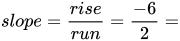
Divide ascent past run to find the gradient. At present that you know these 2 values, plug them into " " to find the slope of the line.
- Example 2 (cont.): -3.
-
4
Review the gradient-intercept form. You can describe a straight line with the formula y = mx + b, where one thousand is the gradient and b is the y-intercept.[vi] Now that we know the slope m and a point (x,y), we can utilize this equation to solve for b, the y-intercept.
-
5
Fit the gradient and point into the equation. Take the equation in slope-intercept form and replace thou with the slope you lot calculated. Supervene upon the x and y terms with the coordinates of a unmarried betoken on the line.[vii] It doesn't matter which point y'all utilize.
- Example ii (cont.): y = mx + b
Gradient = yard = -three, so y = -3x + b
The line includes a point with (10,y) coordinates (1,ii), so two = -3(1) + b.
- Example ii (cont.): y = mx + b
-
6
Solve for b. Now the only variable left in the equation is b, the y-intercept. Rearrange the equation so b is on one side, and yous accept your answer.[8] Retrieve, the y-intercept always has an x-coordinate of 0.
- Example 2 (cont.): 2 = -iii(1) + b
2 = -three + b
five = b
The y-intercept is at (0,5).
Advertizement
- Example 2 (cont.): 2 = -iii(1) + b

-
ane
Write down the equation of the line. If y'all already accept the equation of the line, you can find the y-intercept with a little algebra.[ix]
- Example 3: What is the y-intercept of the line x + 4y = 16?
- Note: Example 3 is a direct line. Encounter the stop of this department for an case of a quadratic equation (with a variable raised to the power of ii).
-
ii
Substitute 0 for x. The y-axis is a vertical line forth ten = 0. This means whatever signal on the y-centrality has an x-coordinate of 0, including the y-intercept of the line. Plug in 0 for ten in the line equation.
- Case 3 (cont.): ten + 4y = sixteen
ten = 0
0 + 4y = 16
4y = 16
- Case 3 (cont.): ten + 4y = sixteen
-
3
Solve for y. The answer is the y-intercept of the line.
- Case 3 (cont.): 4y = 16
y = 4.
The y-intercept of the line is 4.
- Case 3 (cont.): 4y = 16
-
four
Ostend by graphing (optional) . To bank check your answer, graph the equation as neatly every bit yous can. The point where the line crosses the y-axis is the y-intercept.
-
v
Find the y-intercept for a quadratic equation. A quadratic equation includes a variable (x or y) raised to the power of 2. You can solve for y with the same exchange, but since the quadratic describes a curve, it could intercept the y-centrality at 0, ane, or 2 points. This ways you may end upward with 0, 1, or 2 answers.
Advertisement

Add New Question
-
Question
How practise you find the ten-intercept in y = mx + b?

David Jia is an Bookish Tutor and the Founder of LA Math Tutoring, a private tutoring company based in Los Angeles, California. With over 10 years of teaching feel, David works with students of all ages and grades in various subjects, equally well equally higher admissions counseling and test preparation for the SAT, ACT, ISEE, and more than. After attaining a perfect 800 math score and a 690 English score on the SAT, David was awarded the Dickinson Scholarship from the Academy of Miami, where he graduated with a Bachelor's caste in Business Assistants. Additionally, David has worked every bit an instructor for online videos for textbook companies such as Larson Texts, Big Ideas Learning, and Big Ideas Math.
Academic Tutor
Expert Answer
Find the x-intercept by plugging in 0 for the value of y. The 10-intercept will equal whatever value comes out at the other end of the equation.
-
Question
What do you mean past x-intercept in math?
David Jia is an Bookish Tutor and the Founder of LA Math Tutoring, a individual tutoring company based in Los Angeles, California. With over ten years of teaching feel, David works with students of all ages and grades in diverse subjects, as well as college admissions counseling and exam preparation for the Saturday, Act, ISEE, and more. Later attaining a perfect 800 math score and a 690 English score on the Sabbatum, David was awarded the Dickinson Scholarship from the Academy of Miami, where he graduated with a Available's degree in Business organisation Administration. Additionally, David has worked as an teacher for online videos for textbook companies such as Larson Texts, Large Ideas Learning, and Large Ideas Math.
Academic Tutor
Expert Answer
The x-intercept is only wherever the graph crosses the ten-centrality (the direct, horizontal line that cuts through the heart of the graph).
-
Question
If I have (iii, -12) as my points and an x-intercept of one, what would the y-intercept be?

Solve by using Method 2 above. You need 2 points to employ that method. I signal is given as (three,-12). The second betoken is the given x-intercept, which is (1,0).
-
Question
If I am only given one specific bespeak, how can I convert it into slope intercept grade?

Technist
Community Answer
You can't have only one betoken. Imagine yous're standing in the eye of your neighborhood street and have no where to go. No management, no distance, etc. You don't need to go to your friend's house or to school. That is an example of having only i point without whatever other point to go to so there's no line. Thus, no equation. And more than importantly, no math to work out.
-
Question
I practise not get the last role of method two, can you explain?
Using the "slope-intercept" class of the line's equation (y = mx + b), you solve for b (which is the y-intercept you're looking for). Substitute the known gradient for m, and substitute the known point's coordinates for x and y, respectively, in the slope-intercept equation. That will let yous notice b. In the example in Method two, the calculated slope is -3, so m becomes -3. The known indicate is given every bit (ane,2), so x in the equation becomes 1, and y becomes 2. Thus, the gradient-intercept equation becomes two = -three(1) + b. And so two = -iii + b, and b = v. That'due south the y-intercept.
-
Question
What do I practise if the only affair on the other side of the = is a variable?
If you hateful that the only thing on the "x" side of the equation is x (so that y = 10), that indicates a slope (m) of 1 and a y-intercept (b) of zero.
-
Question
How exercise I find the y intercept when it is non numbered and obviously a decimal?

Assuming by numbered yous mean whole number, it doesn't matter, the method is the aforementioned in both cases.
-
Question
How exercise I find the y-intercept if 3x - y = 6?

The graph crosses the y-axis when x=0, so substitute 0 for ten in this equation, and solve for y: y is -6. Since y is -6 when x is 0, the y-intercept is -vi.
-
Question
How do I find the y-intercept if the only given data is the slope and no graph or bespeak(s) specified?
You would have to be given more than information than just the slope in society to find the y-intercept.
-
Question
How do I discover the slope for this and then the y-intercept (0,0) and (4,-3)?
The gradient has a numerator consisting of the difference betwixt whatsoever two x values on the line and a denominator consisting of the difference betwixt the two respective y values. In this case the gradient is (four - 0) / (-3 - 0), or 4 / -3, which equals -4/iii. The y-intercept is the y-value when x=0. In this case, we are told that the line passes through the point (0,0), which means that the y-intercept is zero.


Show more answers
Ask a Question
200 characters left
Include your email accost to become a bulletin when this question is answered.
Submit
Advertising
Video
-
For more complicated equations, try to isolate the terms containing y onto 1 side of the equation.
-
Some countries use a c or another variable instead of b in the equation y = mx + b.[10] This doesn't alter the meaning; it's simply a different tradition.
-
When calculating slope between two points, you can subtract the ten and y coordinates from each other in either order, as long as you put the points in the same order for both ascension and run.[eleven] For example, the slope between (one, 12) and (3, seven) can exist calculated in two different means:
Advertizing
About This Article
Article Summary X
To find the y intercept using the equation of the line, plug in 0 for the x variable and solve for y. If the equation is written in the gradient-intercept course, plug in the slope and the ten and y coordinates for a betoken on the line to solve for y. If you don't know the slope, calculate information technology by dividing the rise of the line past the run. If you want to observe the y-intercept if you only know two points along the line, go on reading the commodity!
Did this summary help you?
Thanks to all authors for creating a page that has been read i,018,997 times.
Did this article help you?
Source: https://www.wikihow.com/Find-the-Y-Intercept

Enregistrer un commentaire for "How to Find Slope When You Know Y Intercept"